
The Problem With AI Home Design for Conroe and Houston Families
I had a client send me an AI-generated room design last year. It was beautiful. The render showed a living room with perfect proportions, a centered coffee table on a textured rug, styled accessories on a side table, and warm lighting that caught every corner of the space.
She asked me what I thought.
My first thought: that is exactly where her babies crawl.
She had a newlywed family with little ones still on the floor. The coffee table in the render had sharp corners at toddler height. The accessories on the side table were positioned precisely where an eighteen-month-old could reach them. The fabric on the sofa was a stunning ivory linen that would not survive one Tuesday morning.
The render was beautiful. It was wrong for her family in about six different ways.
AI design tools are getting better fast. Some of them are genuinely impressive. But there is a gap between what a tool can render and what a designer can design, and the families I work with across Conroe and Montgomery County deserve to understand where that gap lives before they act on a recommendation from software that has never met them.
What AI Design Tools Are Actually Good At

AI tools are real. They are useful. I am not going to pretend otherwise. We use them ourselves for certain stages of the process.
Mood Boards and Visual Exploration
When a client cannot articulate what they want, an AI mood board helps them find it fast. They generate a render, point at it and say “that feeling, but warmer” or “this palette, but I hate that rug,” and suddenly we are in the same visual conversation. That is a real time-saver in early discovery.
The American Society of Interior Designers documents how visualization tools have accelerated early-stage client communication. We agree with that finding. Starting from a visual reference beats starting from nothing.
Color Palette Testing
AI tools are strong at generating color combinations quickly. They can show you what a terracotta wall looks like against white oak cabinetry in seconds, without a paint commitment. For homeowners trying to settle on a direction, that speed has real value.
Showing “What’s Possible”
Sometimes a client cannot picture what a space could become. A render showing an open-plan kitchen with a central island helps them say yes to a renovation they were nervous to start. As a communication aid at the inspiration stage, AI renders are genuinely useful.
None of that is the problem.
The Coffee Table Problem

The problem starts when the render becomes the decision.
What the Render Looked Like
The room the AI generated for my client was objectively good aesthetics. Balanced proportions. A rug that anchored the seating group. A coffee table with clean lines in a material that photographed beautifully. The accessories on the side table were styled the way you would see in a Houston design magazine and stop to look at.
The AI optimized for visual appeal. That is exactly what it was built to do.
Where the Baby Crawls
Here is what the AI did not know: my client had two children under the age of three. Her babies spent most of their waking hours on that floor.
The coffee table in the render sat at precisely the height where a child stands up for the first time and catches the corner with the side of their face. The accessories on the side table were at arm-reach for an eighteen-month-old. The linen sofa fabric would not survive a single morning of real family life.
As I explained it to her: you cannot put a coffee table where AI has staged one for you because the babies are still using that space to crawl, to play, to learn. That is not the real-life story. The real-life story is your floor, your kids, your Tuesday.
What We Asked Instead
When we started our actual discovery, the questions were different from anything a software tool asks.
How does your family move through this room? Where does the baby pull up to stand? Do your kids do homework in here? Does your dog have a route around the furniture? Is this the room where Sunday morning happens, or is it the formal room you rarely actually use?
Those answers change every decision. The coffee table moved. The fabric changed. The side table accessories dropped to a safer height. The render became a direction, not a blueprint.
That is the difference between a render and a design.
The Materials AI Cannot Evaluate
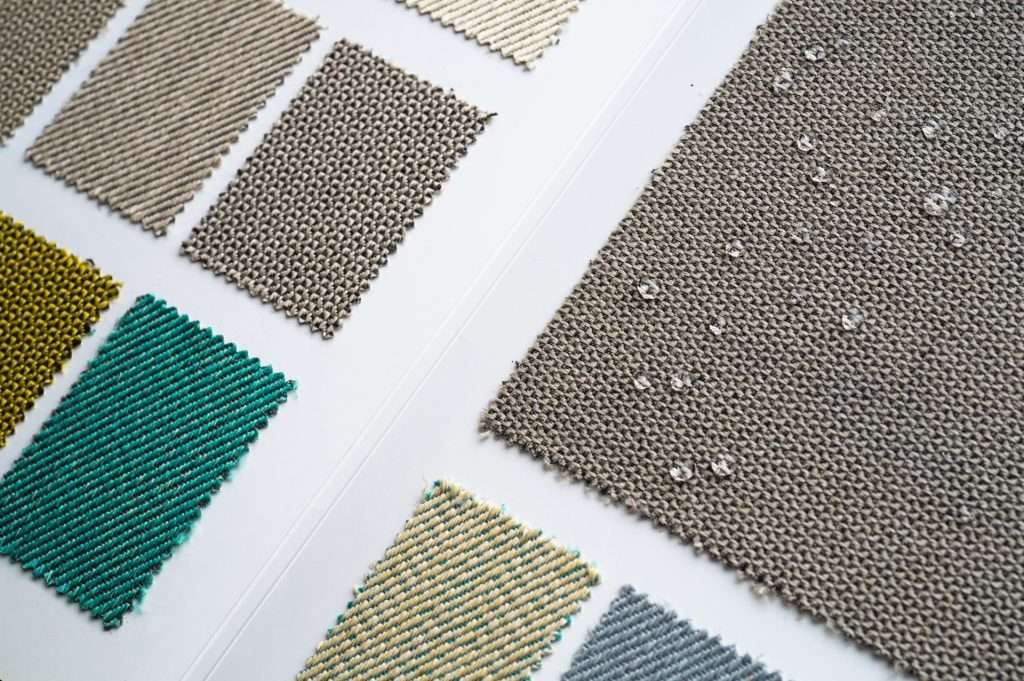
The visual gap in AI design is real. The materials gap is the one that costs families real money.
The Fabric Decision AI Gets Wrong
We do not spec upholstered furniture without an in-person conversation.
The reason is the fabric demo we run at every consultation. We set two swatches on the table: one performance fabric, one lifestyle fabric. Then we pour grape juice on both.
The performance fabric beads immediately. The liquid sits on the surface of the weave and does not absorb. We count to six, press one finger to the fabric, and dab. It lifts completely. The swatch is dry.
The lifestyle fabric darkens faster. The liquid is working its way into the fiber before the six seconds are up.
We have done that demo with every client we have worked with over the past eight years. The performance fabric argument has never been lost after the pour.
An AI tool will recommend the ivory linen sofa because it looks beautiful in the render and reads well against the color palette. The tool does not know you have two dogs and a toddler. It was not trained to ask. We were.
For a full breakdown of how material choices affect Houston-area remodel value, our post on remodeling your space without overspending covers the decisions that hold up and the ones that do not.
Houston Climate Is Not a Variable in the Render
There is a second material problem specific to where we live.
The heat index in Houston is different from California, New York, or anywhere else. It behaves differently on materials over time. Houston floods. LVT flooring has become the standard in Conroe and Montgomery County homes specifically because it handles what this climate asks of it.
The same tile that sits perfectly natural in a Conroe bathroom would crack in the freeze-thaw cycles of a New York winter. An AI tool trained on design images from across the country does not know what county you are in, what your flood zone looks like, or what Gulf Coast humidity does to materials over ten years.
The World Floor Covering Association publishes climate-specific installation guidance for a reason. Regional material performance is a real variable. It does not show up in a render.
The Family-Over-Time Problem
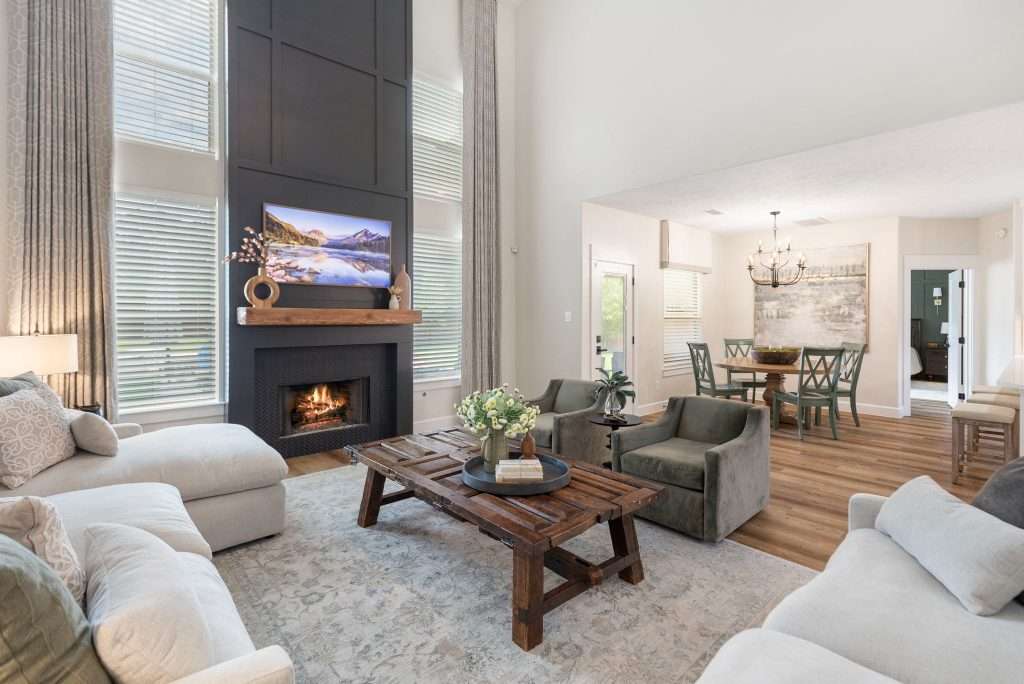
Most of the families we work with in Conroe and the greater Montgomery County area are not staging their homes for resale. They are designing for the next fifteen years.
Designing for Who You Will Be
A newlywed couple with babies today will have school-age children in seven years and teenagers in twelve. The toddler-height coffee table problem solves itself eventually. The flooring that could not handle Houston summers becomes a problem that compounds every year.
The decisions made today should account for who the family is going to be, not only who they are right now. That means flooring that handles the long game. Built-in storage that does not become obsolete when the kids age out of their toy phase. Kitchen island heights that work for homework before they work for entertaining.
An AI tool has no idea when your baby becomes a teenager. It was built around the image you uploaded today.
The National Association of Home Builders tracks how many homeowners plan to stay in their current homes long-term. The numbers are consistent: most of the families we work with across Montgomery County are making decisions they will live inside for decades. That is not a render problem. It is a life problem.
For more on why the decision-making phase matters as much as the design phase itself, our post on the benefits of planning ahead covers the structural questions that save money later.
What AI Cannot See on a Job Site
Software is trained on images. It does not have a job site.
Eight Years of Field Knowledge
Our work runs on five trades who have been with us for eight years: Manny is the carpenter, Edward is the plumber, Carlos handles tile, Ralph handles flooring, and Angel paints. Each one is a specialist in one craft. Across those eight years, they have seen what fails and what holds in this climate specifically.
When Carlos installs tile in a Conroe bathroom, he knows the substrate behavior here. He knows which adhesive holds in Gulf Coast humidity and which one starts to lift in year three. When Ralph selects LVT for a Houston-area family room, he knows which underlayment works with the slab behavior common in this region.
None of that knowledge lives in a render. It lives in eight years on the job site, watching what happens and adjusting.
Installation Standards Exist Because Failures Are Predictable
The Tile Council of North America publishes installation standards specifically because real tiles in real climate conditions fail in predictable ways when the right practices are not followed. A render has no reason to care about installation standards. A designer who answers for the work has every reason to.
AI tools are trained on finished rooms. They are not trained on the failures that happen when the right steps are skipped.
The Hidden Risk of Acting on a Render
There is a practical danger most homeowners do not think about until it is already a problem.
AI renders frequently show structural changes without flagging them. An open-concept kitchen that removes a wall. A bathroom expansion that moves plumbing. These look as simple as any other design element in a render. In reality, they require permits, structural assessment, and licensed trade professionals.
Texas does not require a contractor to be licensed or registered to operate. (R13) Any handyman with a truck and a phone can call himself a contractor. The question to ask is not whether someone is licensed. The question is whether they are insured. An insured contractor has paid real money to underwrite their work, which means they are held to a building-code standard an uninsured handyman is not.
The Texas Department of Licensing and Regulation governs specific trade specializations but not general contractors. Understanding what that gap means for homeowners acting on a render without professional oversight is important. Uninsured work, unpermitted structural changes, and material failures discovered after the job is complete are expensive to correct.
Acting on a render is not the same as having a design. The difference shows up at permitting, at installation, and sometimes years later when the work fails.
For a detailed look at what to watch for before a bathroom project specifically, our post on why bathrooms matter long-term covers the decisions that hold their value and the ones that do not.
How to Use AI Tools Right
AI tools are not the problem. Acting on them without a filter is the problem.
Use Them for Inspiration, Not Decision
Use an AI render to find a direction. Use it to show your designer a feeling, a color palette, a proportion you responded to. That is the right job for a render. It narrows the conversation fast and gives you a visual language you can share.
It should not determine your material choices, your furniture selection, your traffic pattern, or your structural layout. Those decisions require someone who knows your family, your climate, your budget constraints, and your specific space.
What to Bring to Your First Consultation
When you sit down with a designer, bring the AI renders you generated. They are a starting point, not a specification. A good designer will ask which elements you responded to and why, then start building from the family story you actually have, not the idealized version the software generated.
We work with clients across Conroe, The Woodlands, Houston, and surrounding Montgomery County. The questions we ask in an in-person consultation are the ones AI cannot ask: how do you live in this room? Who uses it and when? What are you afraid of in this space? What would make you proud to walk a guest through it?
Those answers are where the design starts.
If you are in the early stages of thinking through a bathroom remodel or a kitchen renovation in the Conroe area, and you have been working with AI renders to explore the possibilities, that is a solid starting point. Bring everything you have gathered to the consultation. We will start from there.
Frequently Asked Questions
No. AI tools can generate useful visual inspiration and help homeowners explore options quickly. They cannot account for family lifestyle, material durability in a specific climate, structural constraints, or the field knowledge built from doing the physical work in a region over years. Inspiration and design are two different things.
Use them for mood boards, color palette exploration, and early-stage visual direction. They are fastest at showing you what is possible in a space and helping you name a feeling. Bring that output to your first consultation as a conversation starter, not a specification document.
Materials behave differently in different climates. In the Houston and Conroe area, Gulf Coast humidity, flooding risk, and heat index all affect how materials perform over time. LVT flooring has become the standard in Montgomery County homes because of flood resilience. A design tool trained on images from across the country does not know your regional conditions.
Any material recommendation for upholstered furniture should start with a durability conversation. Performance fabric, engineered from the fiber up rather than treated after manufacturing, is the right choice for families with children and pets. The in-person consultation includes that conversation and a hands-on comparison before any selection is made.
A render shows what a space could look like under ideal visual conditions. A design accounts for how the family lives in the space, what the materials cost to maintain, how the space handles the local climate, what construction work requires in terms of permits and professional trades, and what the space will look like in ten years, not just in the day-one photograph. A render is where the conversation begins. A design is where it ends.
The Render Is Where the Conversation Begins
If you have spent an evening running your home through an AI design tool, that is a reasonable starting point. The images it generates can be genuinely helpful for finding a direction.
The step that matters is what comes after.
Acting on a render without the conversation that turns inspiration into something your family can actually live inside is where the risk lives. The families we work with across Conroe, Montgomery County, and the greater Houston area are designing spaces they intend to stay inside for the next fifteen years. The questions that matter at that scale are not answered in a render. They are answered when we sit down together, look at your floor plan, learn how Tuesday morning works in your house, and start making decisions built around your actual life.
When you are ready for that conversation, reach out to us.
The AI renders you built are a great place to start. We will take it from there.