
Curves, Arches, and the Builder-Grade Bathroom Problem in Texas
Curved bathroom design has been quietly taking over 2026 renovation Pinterest boards for a reason, honey. Most Texas builder bathrooms from the last fifteen years were built at right angles. Flat slab counter. Rectangle mirror. Square shower niche. Boxy tub alcove.
Every single surface meets the next at 90 degrees. On paper, that reads as clean and modern. In real life, it reads as cold. You know that feeling when you walk into a bathroom that looks fine in listing photos but feels vaguely clinical on a Tuesday morning? That’s what a room of right angles does to us, darling.
The fix that’s sweeping bathroom design right now has nothing to do with expensive materials. Everyone’s softening the shapes. Stick around.
Why Bathrooms Built Ten Years Ago Started Feeling Hospital-Like
Bathrooms built in the 2010s started feeling hospital-like because every element in them was pulled from the same right-angle catalog. Straight-edge rectangular mirror. Slab countertop with sharp 90-degree corners. Square shower niches. Boxy alcove tubs. No single choice was wrong on its own. Stacked together in a small room, they turned the bathroom into the hardest-edged space in the house.
We spend a lot of time in our bathrooms. Morning and evening. Good days and rough days. Every surface we look at sends a signal to our nervous system, sugar, whether we realize it or not. When every surface is a sharp right angle, the signal is “efficient workspace,” not “calm retreat.”
Designers in the trade press have been flagging the shift for a couple years now. Writing for Livingetc, designer Sofia Charalambous of Origins Living put it plainly: arches, ovals, and irregular organic outlines are everywhere, and they soften the straight lines of tiles and cabinetry to create a calming flow that makes even small bathrooms feel more inviting. That’s the opposite of the builder-grade default.
The practical result? Small Texas bathrooms hit the hardest. Half-baths tucked under the stairs. Secondary bathrooms off guest bedrooms. Master baths in 2,500-square-foot builder homes with three actual rooms. Every one of those spaces amplified the visual hardness because there wasn’t enough square footage to break up the right angles.
That’s exactly the kind of design tension a small layout tweak can shift without a full renovation.
What’s Actually Changing: The Soft-Shape Shift Across 2026 Bathroom Design
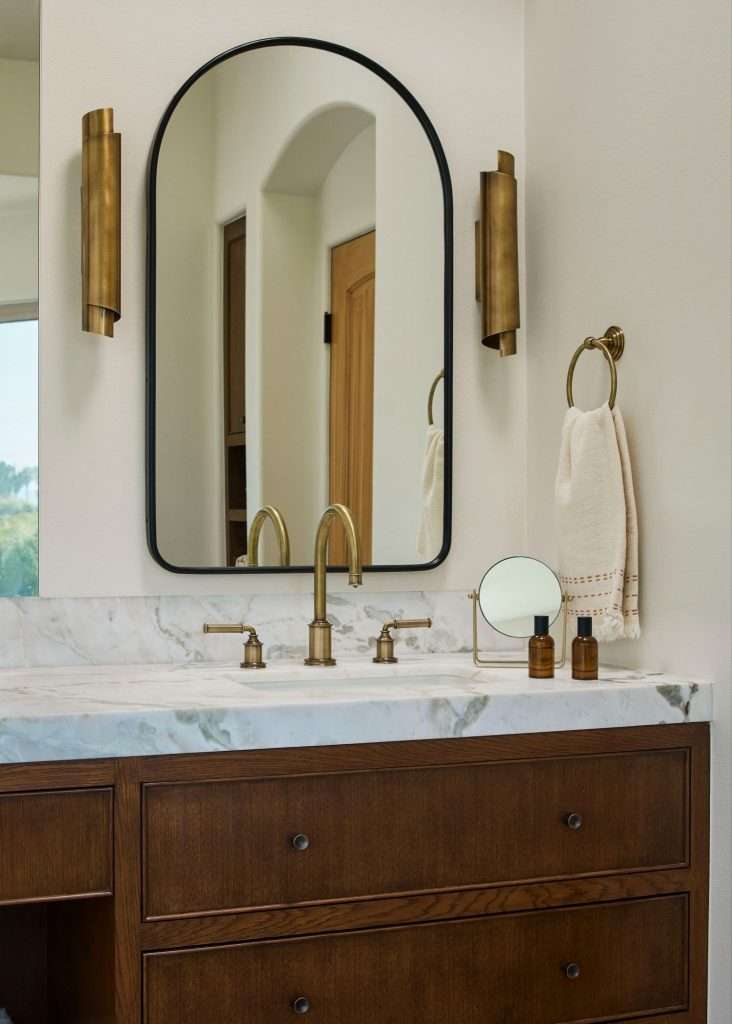
The 2026 bathroom design shift centers on replacing sharp geometric edges with curved, organic, and arched forms across mirrors, vanities, tubs, and architectural openings. This isn’t one trend. It’s five related trends moving in the same direction at the same time, and together they’re reshaping how bathrooms feel.
Here’s what trade designers are actually calling out for 2026:
- Arched and organic-shaped mirrors. The rectangular builder mirror is the first thing most homeowners swap out, because it’s the cheapest change with the biggest visual payoff. House Digest’s 2026 mirror coverage identifies arch-shaped, oval, and irregular organic mirrors as the dominant look, with designers framing them as a calming counterweight to straight tile and cabinetry lines.
- Curved and carved stone vanities. Decorilla’s 2026 bathroom trend analysis highlights basins curving inward and countertops tapering at the edges. Honed stone replaces polished. Rounded profiles replace 90-degree overhangs. Everything feels easier on the eye.
- Fluted vanity fronts. These are ripple-textured cabinet fronts that catch light and add tactile interest without adding cleaning headaches. They bridge curves and straight lines, which is why they’re showing up in transitional Texas homes more than almost any other 2026 element.
- Arched shower niches and doorways. A simple arched opening in place of a squared-off niche or a standard door frame changes the entire visual rhythm of a bathroom. It’s also surprisingly affordable during a remodel because it’s a framing decision, not a materials decision.
- Softened tub silhouettes. Freestanding tubs with curved chubby profiles have replaced the sharp-edged alcove look. Designer commentary documented by Porcelanosa’s 2026 trendbook notes that tactile, wave-inspired surfaces paired with smooth finishes define the new bathroom aesthetic.
All five trends share one underlying idea: a bathroom should feel calming, not clinical. That’s the whole shift in one sentence, baby. The direction tracks with what the National Kitchen & Bath Association’s 2026 Bath Trends Report found across nearly 700 industry designers, where organic and natural design ranked as the second most popular style direction for the next three years, right behind transitional and timeless.
Our team helps families across Conroe and The Woodlands figure out which of these five moves actually fits their existing bathroom bones. Not every trend belongs in every room.
Five Places Curves Show Up in a Real Bathroom, and What Each One Does
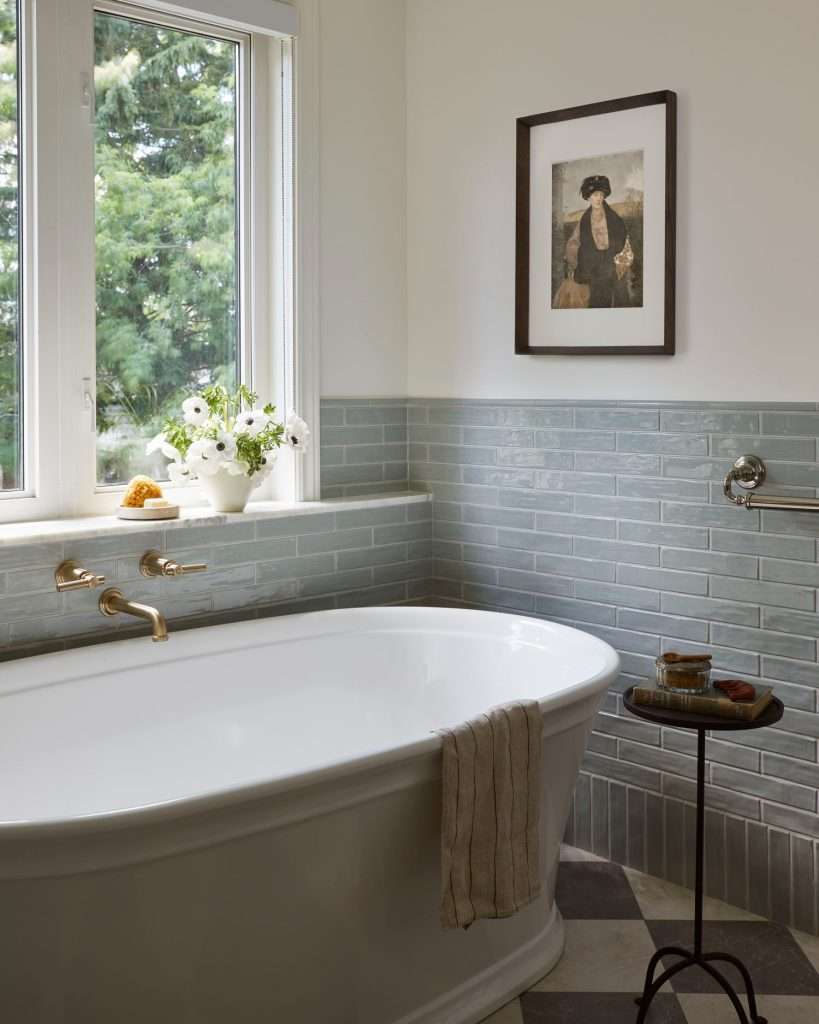
Curves and arches show up in five distinct places in a typical bathroom renovation, and each one serves a different design purpose. Knowing which placement delivers the visual shift you’re looking for helps you decide where to spend and where to hold back.
- Mirrors. The single highest-impact curve move, hands down. Swapping a builder-grade rectangle for an arched or oval mirror changes the visual center of gravity of the whole room. Your eye stops at the mirror, which is the focal point, and the curve becomes the first thing you notice instead of the hardest edge.
- Vanity fronts. Fluted or curved vanity cabinet fronts add texture without shouting. They work especially well when the mirror stays simple, because the vanity takes over as the feature. In small Texas powder baths, this is often the one move that transforms the space.
- Tub silhouettes. A freestanding tub with a rounded, organic shape reads as sculpture, not plumbing. In master baths, it becomes the focal point the whole room orients around. The tradeoff is cost and space; freestanding tubs need floor clearance that alcove tubs don’t.
- Shower niches and shampoo nooks. An arched niche instead of a squared-off rectangle softens what’s often the most visually jarring element in a shower. This is the cheapest curve move to add during a shower remodel. It’s a tile-layout decision, not a fixtures decision.
- Arched doorways. A curved doorway into the bathroom, or an arched passage between a bedroom and an ensuite bath, changes how the entire room reads from the hallway. It’s the most architectural of the curve moves and the one that requires the most commitment during a remodel.
The rule to hold in your head, hun: pick one or two places for the curve, not all five. A bathroom where every element is curved starts looking like a cartoon version of itself. Restraint is what makes this trend work.
For a look at how these elements integrate in a real remodel, our Ben bathroom project shows the thinking behind where to soften and where to keep clean lines. The team at Design on a Dime Interiors helps Spring-area families work through these tradeoffs before any tile goes up.
When Curves Work in a Builder-Grade Bathroom, and When They Look Bolted On
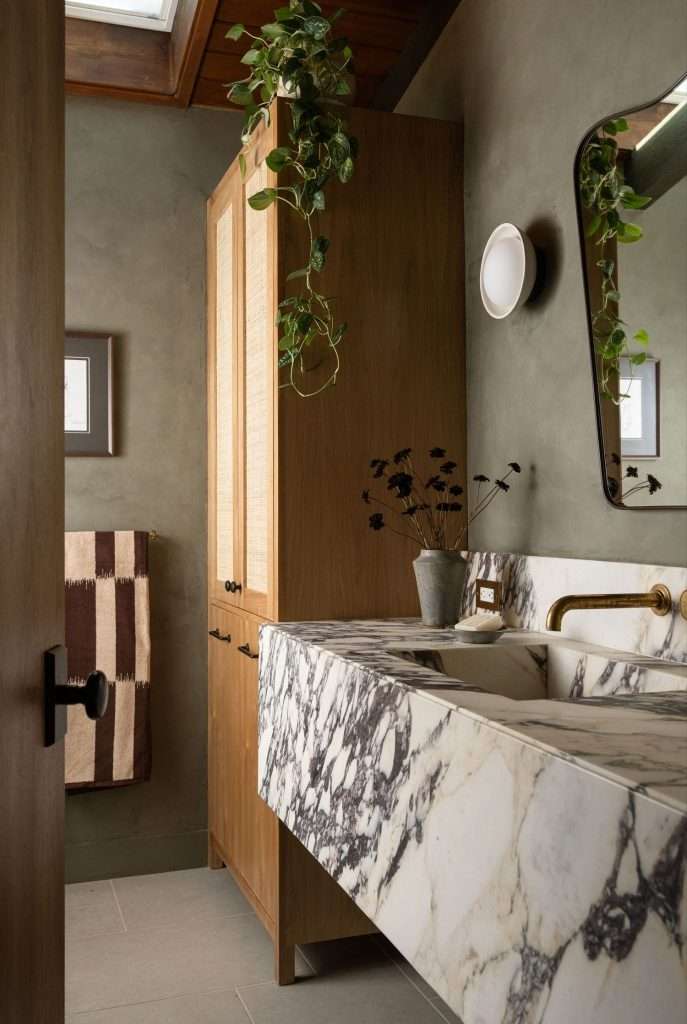
Curved and arched elements work in a builder-grade bathroom when they’re integrated with at least one other design change, and they look bolted on when they’re introduced as a single swap into an otherwise untouched space. That’s the core rule. Everything else is details.
Here’s how the math actually plays out:
- Single-swap curves rarely land. Changing only the mirror in an otherwise all-rectangle bathroom makes the mirror look like it wandered in from another house. The eye immediately registers the mismatch. You can get away with one swap if the rest of the room already has some visual softness (natural materials, warm lighting, textured tile), but not if everything else is still builder-beige and right-angled.
- Two-element changes create coherence. Arched mirror + fluted vanity. Curved tub + arched shower niche. Two curve elements read as intentional design, not a one-off purchase.
- Three or more changes feel fully designed. This is the remodel tier. Arched doorway + curved vanity + organic mirror shapes a room that feels completely current. Usually the budget tier too.
- Pairing curves with natural materials helps. Wood, stone, and natural-texture tile soften the whole room before the curves even go in. Curves against high-gloss builder-white tile and chrome fixtures can still read clinical.
- Lighting carries more weight than people realize. Recessed can lights kill the curved-mirror effect because the light flattens the shape. A sconce, a pendant, or a backlit mirror brings the curve to life. Fixing hard-edged lighting is one of the underlying bathroom stress points that homeowners often miss when they focus only on finishes.
This is the exact kind of calculation worth running before you commit. Our bathroom remodel cost calculator helps you see what a full renovation costs against a lighter-touch update, so you’re choosing based on actual numbers instead of guessing. Families across Cypress and the broader Greater Houston market use it to sanity-check scope before any tile gets ordered.
The Quiet Advantage in a Small Powder Bath
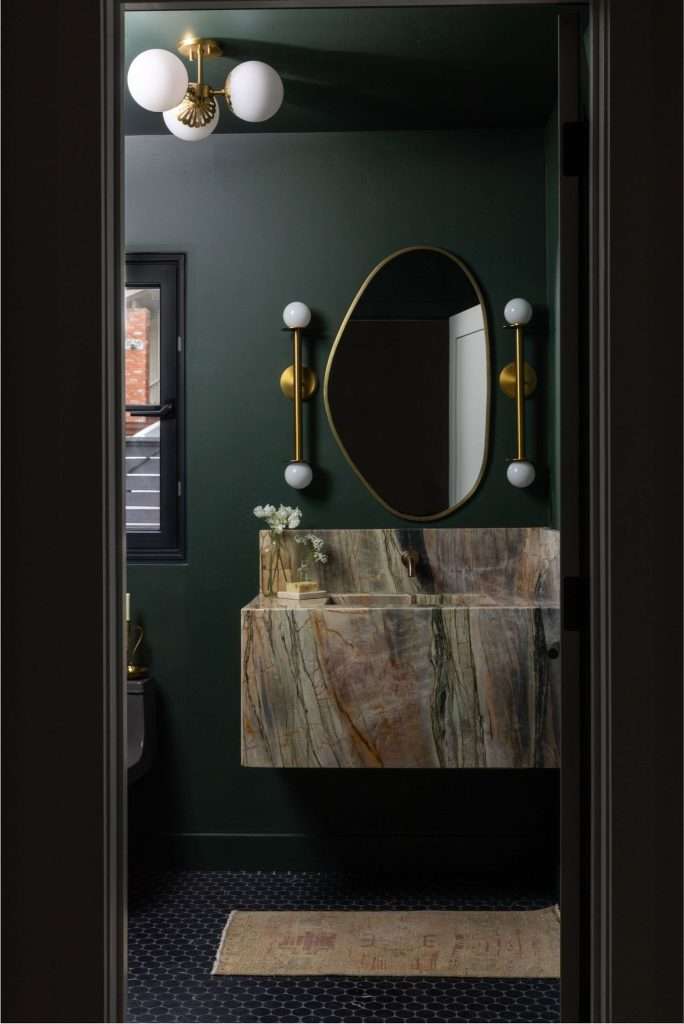
Small Texas powder baths benefit disproportionately from a single curved element because the whole room can be transformed with one swap, without the integration math that larger bathrooms require. Tuck one curve into a 20-square-foot half-bath and the entire space feels different. Honey, this is where the trend delivers the most bang for your buck.
Powder baths are everywhere in Texas homes. Under the stairs. Off the foyer. Tucked beside the dining room. Most of them are 20 to 40 square feet, which means every surface is within 6 feet of every other surface, and every design choice amplifies.
The two moves that consistently transform a small Texas powder bath:
- An arched or organic-shaped mirror. In a small space, the mirror is visually the biggest element in the room. Changing its shape changes the whole room. This alone is often enough.
- A fluted or curved vanity front. If you’re not ready to replace the mirror, a fluted vanity front delivers the textural softness the same way. When guests come in, it’s the one element their hand touches, so texture matters disproportionately.
One curve is enough in a powder bath. Two can work if they’re in harmony. Three starts looking over-designed in a small footprint. There’s more on getting the small bath right in our breakdown of what makes a well-designed powder bath.
For homeowners in Magnolia looking at a curved or fluted vanity as part of a powder bath refresh, custom cabinetry gives you the shape and the size exactly right for the space, rather than forcing a stock vanity into an odd footprint.
How to Mix Curves and Straight Lines Without Creating a Mess
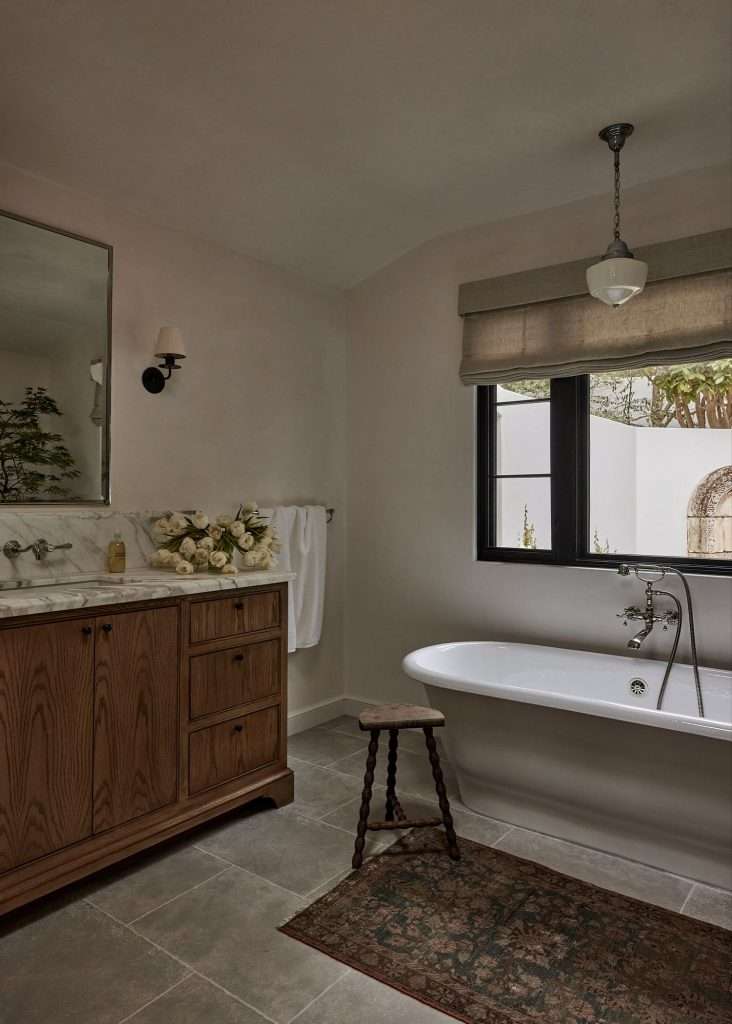
Mixing curves and straight lines works when the curves are concentrated in one or two elements and the straight lines handle everything else, creating a clear hierarchy instead of visual competition. The failure mode is treating every element as equal. That creates chaos.
Here’s the framework:
- Pick the hero curve. Decide which element is the curved focal point before anything else, darling. Mirror, tub, or doorway. Usually just one. That element gets to be loud.
- Let the supporting cast stay simple. If the mirror is the hero, the vanity should be clean-lined. If the tub is the hero, the mirror stays classic. Everything else serves the hero, not competes with it.
- Keep the tile straightforward. This is where folks go wrong most often. Curved elements against busy patterned tile is too much. Classic subway tile, large-format slabs, or simple hex patterns let the curves do the work.
- Match metal finishes and tonal families. Mixing curves and straight lines is already a visual contrast. Don’t add metal-finish contrast on top of it. One warm metal (brass, bronze) or one cool metal (brushed nickel, matte black) running through the whole room.
- Consider scale. A small curve in a big bathroom gets lost. A big curve in a small bathroom feels overwhelming. Match the scale of the curve to the scale of the room.
There’s a real parallel here to what designers notice when walking into a room, which is mostly about visual hierarchy and whether one element is clearly leading. When mixing curves and straight lines, the hierarchy is the whole game.
Getting the vanity shape and scale right for a specific bathroom is exactly where custom cabinetry pays off. Our team at Design on a Dime builds custom vanities sized to the exact footprint, which makes the hierarchy easier to control.
The Shortlist of Curve Choices That Actually Age Well
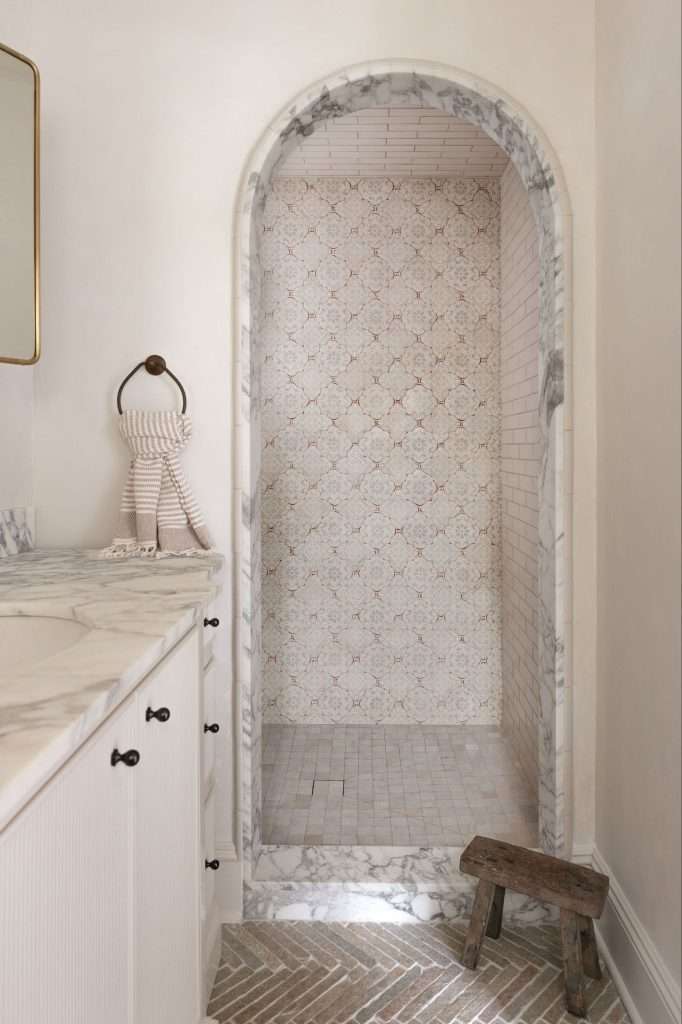
Four curved bathroom elements have a strong track record of aging well, and three trendier moves carry more aesthetic risk over a five- to ten-year horizon. Separating the two matters more than most homeowners realize, because bathrooms don’t get updated often, honey. The shape you pick today has to last.
The four that consistently age well:
- Arched mirrors. Arches are architectural. They’ve been used in buildings for thousands of years. An arched mirror will not look dated in 2036. The specific frame finish might cycle, but the shape is classical.
- Fluted or reeded vanity fronts. Fluted texture shows up in architecture across every century. It’s subtle enough that it reads as detail, not statement. Easy to live with long-term.
- Softly curved countertop edges. A quarter-inch or half-inch radius on a slab edge is barely visible as a trend move. It reads as good craftsmanship. Bathroom countertops with softened edges have been specified by designers for decades.
- Arched doorways and passages. Architectural curves integrated at construction level are permanent design moves. They don’t date because they’re structural, not decorative.
The three that carry more aesthetic risk:
- Highly organic “blob” mirror shapes. Irregular asymmetrical shapes are photogenic but peak in specific style cycles. A curvy organic mirror picked today may read as distinctly 2025-to-2027 in the future. That can be fine if you plan to swap mirrors. It’s a problem if you’re building the whole bathroom around it.
- Chubby or wavy freestanding tubs. Sculptural tubs with exaggerated curves read as statement pieces. Statement pieces date. A cleaner rounded silhouette ages better than a dramatic one.
- Scalloped or cloud-shaped tile patterns. These are having a moment. The moment will pass. If you love them enough to re-tile in eight years, great. If not, hold back on this one.
Scalloped or cloud-shaped tile patterns. These are having a moment. The moment will pass. If you love them enough to re-tile in eight years, great. If not, hold back on this one.
The honest test for any curve move: picture it in 2036. If the answer is “yeah, that still looks fine,” it’s worth doing. If the answer is “eh, probably dated by then,” save it for lower-commitment elements like decor and mirrors you can swap.
For families looking at a bathroom renovation, our team at Design on a Dime helps Montgomery County homeowners separate the lasting moves from the trendy ones before finalizing scope.
Frequently Asked Questions
Curved fixtures are not meaningfully harder to clean than flat ones in most cases. Smooth rounded surfaces actually shed water and soap residue more easily than square corners where buildup collects. The exception is heavily fluted or scalloped surfaces, which add seams that trap more residue. For day-to-day cleaning, curved countertop edges, rounded basins, and arched mirrors are no harder to maintain than their square counterparts.
Curved elements generally make small Texas bathrooms feel larger, not smaller. Soft shapes reduce the visual weight of individual elements and eliminate the harsh corners that emphasize a room’s small footprint. An arched mirror reflects more usable light than a rectangular one of the same surface area. A rounded vanity front reads as lighter than a sharp-edged box. In powder baths under 40 square feet, a single curved element often expands the perceived space more than any paint color or lighting change.
Yes. Three curve moves are possible without a full renovation. An arched or organic-shaped mirror swap is the easiest and typically requires no construction. A fluted vanity replacement uses existing plumbing if the sink location stays the same. A retrofit arched shower niche is possible during a shower re-tile without moving plumbing. More ambitious moves like arched doorways, freestanding tubs, or full vanity customization typically require a renovation-level scope.
The trend itself is unlikely to look dated in five years because architectural arches and softened silhouettes have a long historical track record in interior design. Specific current expressions may cycle out, particularly exaggerated organic mirror shapes and heavily sculptural tub silhouettes. The underlying principle of soft shapes replacing sharp right angles has been returning to bathroom design repeatedly for a century. Classic executions of the trend (arched mirror, fluted vanity, curved-edge countertop) tend to age gracefully. Statement executions carry more risk.
A Bathroom That Feels Like a Retreat, Not a Utility Closet
Look, baby, the reason curves are having a moment in bathroom design isn’t because designers got bored of rectangles. It’s because most of us spend real, intimate time in our bathrooms, and sharp right angles send the wrong signal for a room where we’re trying to start and end our days calmly.
A single curved element can shift a whole room. A thoughtful mix of two or three changes the bathroom entirely. The key is knowing where to soften and where to keep the clean lines that make the curves stand out in the first place.
Builder bathrooms don’t have to stay hospital-hard. Most of them respond beautifully to one or two strategic curve moves without a down-to-studs remodel.
That’s the kind of judgment call where a professional design perspective pays for itself.
Design on a Dime Interiors helps families across Montgomery County and Greater Houston rework bathrooms so they actually feel like retreats, not the hardest-edged room in the house.
If you’re thinking about softening your bathroom with curves or arches, reach out to our team today.