
Small Space, Big Impact: The Quiet Luxury of a Well-Designed Powder Bath
You know that quiet luxury of a well-designed powder bath? Oh, honey, it can leave one of the biggest impressions, even if it’s one of the smallest rooms in your home.
Guests notice the moment they step inside.
The lighting feels warm, the mirror reflects just right, and somehow the whole space feels polished without trying too hard.
That quiet elegance isn’t about square footage and expensive materials, darling. It comes from thoughtful choices that make the room feel balanced, welcoming, and just a little bit special.
The beauty of a powder room is that even small details can shape the entire experience. And when those elements come together, the result is… well, your home’s biggest design flex.
Stick around, because the devil’s definitely hiding in these delicious details.
Why the Vanity Wall Sets the Tone for a Well-Designed Powder Bath
If you think about it, the vanity wall is the first thing folks notice when they walk in. It’s a natural focal point. The mirror, the sink, the faucet, and the lighting all live in here, so the design choices you make in this one area quietly shape the whole experience of the room.
That’s why this is one of the best places to start. When the vanity wall feels balanced and layered, the rest of the powder bath tends to fall into place.
Mirrors That Anchor the Room
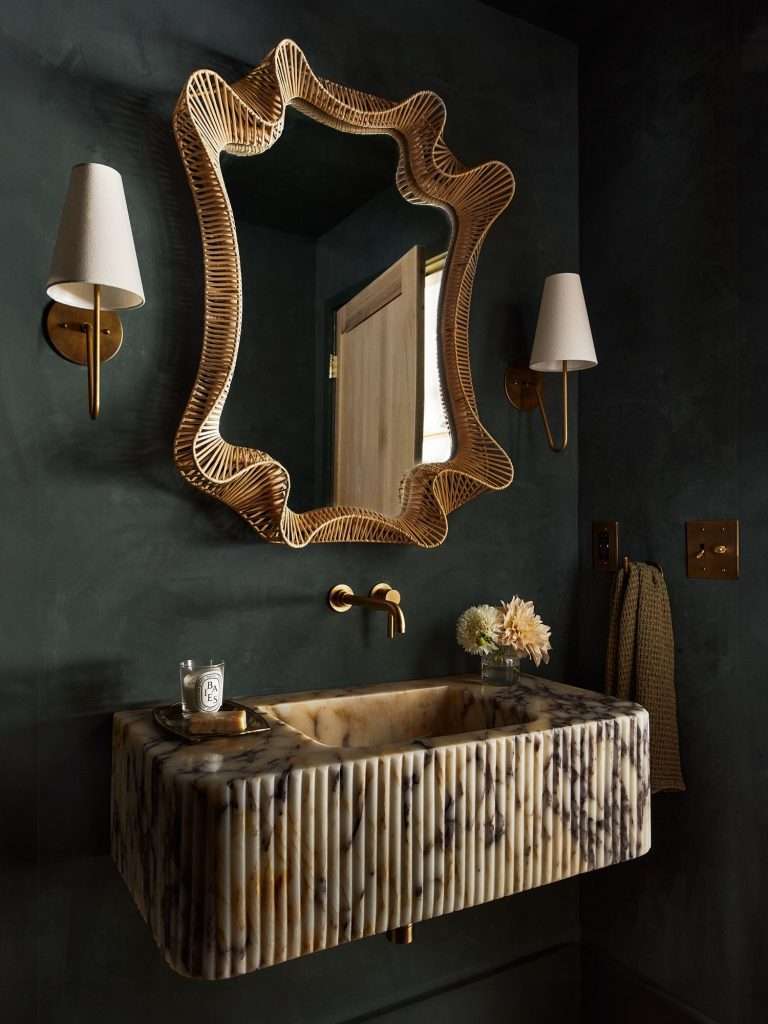
Look, hun, I know you’ve been obsessing over finding the perfect vanity, scrolling through Pinterest boards at midnight, comparing cabinet finishes like your life depends on it.
But here’s the thing:
The mirror is actually doing all the heavy lifting in that powder room.
Your vanity just sits there looking pretty. But your mirror?
It’s actively transforming proportions, amplifying natural light, and creating that “wow” moment your guests remember.
That gorgeous frame above your sink is working overtime in the role of the room’s visual anchor, setting the entire aesthetic tone while bouncing light around like nobody’s business.
Of course, shape matters.
A tall mirror can stretch the room vertically and make the ceiling feel higher; a wide one can visually widen the wall and soften proportions. Framed mirrors can add presence, while thinner metal frames keep things light and modern.
When a Console Sink Works Better Than a Vanity
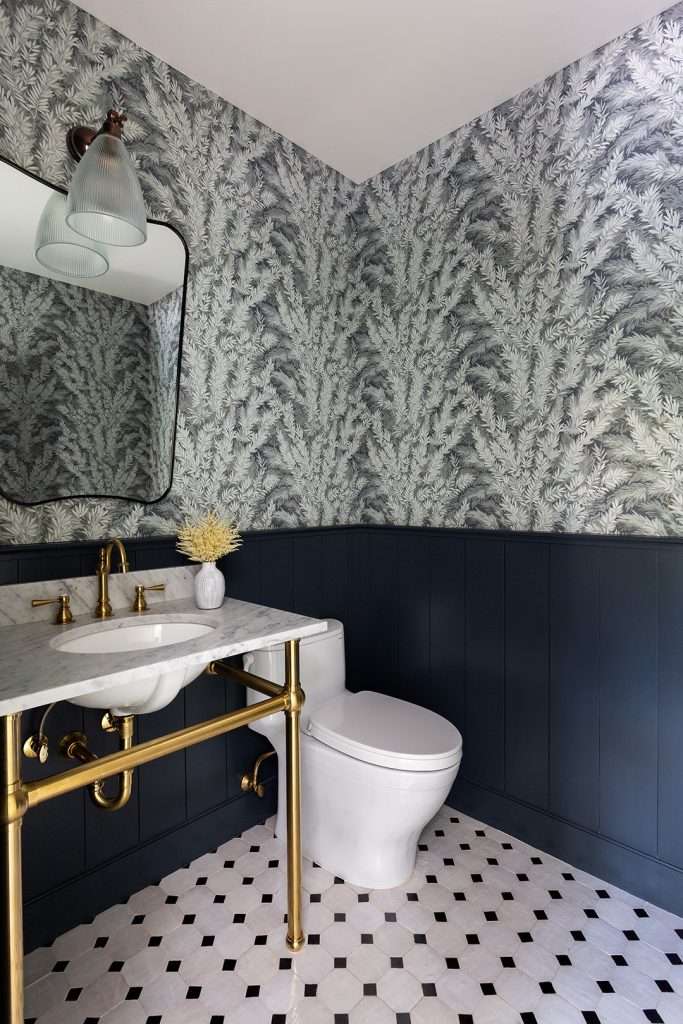
Okay, hear me out:
Sometimes, the smartest choice is to skip the vanity altogether.
Console sinks and pedestal sinks are especially helpful in tighter powder rooms where every inch matters. Because they expose the floor beneath them, they create a sense of openness that a full cabinet cannot always provide.
And that extra breathing room?
It can make a small powder bath feel noticeably larger.
Storage is the tradeoff here, of course, but in a powder room, that’s rarely a problem. Guests usually need nothing more than soap, hand towels, and maybe a small tray for essentials.
The Design on a Dime Interiors team usually begins powder bath remodels right here, helping you choose mirrors, fixtures, and layouts that’ll make even the smallest spaces feel intentional and beautifully finished.
The Designer’s Scale Trick for Making Small Powder Rooms Feel Bigger
Small powder rooms don’t have the luxury of extra square footage. But you know what’s wild? The size of your tiles, the height of your vanity, and even your paint color can literally trick your brain into seeing more square footage than you actually have.
The trick is simple once you see it, really.
I’m about to blow your mind with a few sneaky design moves that’ll make your tiny powder room feel like it doubled in size overnight.
Large Format Tile for a Seamless Look
Large-format tile can work wonders in a compact powder bath.
Because the tiles cover more surface area, there are fewer grout lines breaking up the floor or wall. That uninterrupted surface helps the eye travel across the room without stopping, which creates the impression of a larger space.
That’s why most designers reach for tiles in sizes ranging from 12 x 24 inches or larger. When paired with grout that closely matches the tile color, they offer a streamlined look that eliminates visual breaks.
Another plus?
Fewer grout lines mean less scrubbing and zero mildew nightmares ‘cause there are fewer places for dirt or moisture to collect. You can thank me later, sugar.
Floating Vanities That Create Breathing Room
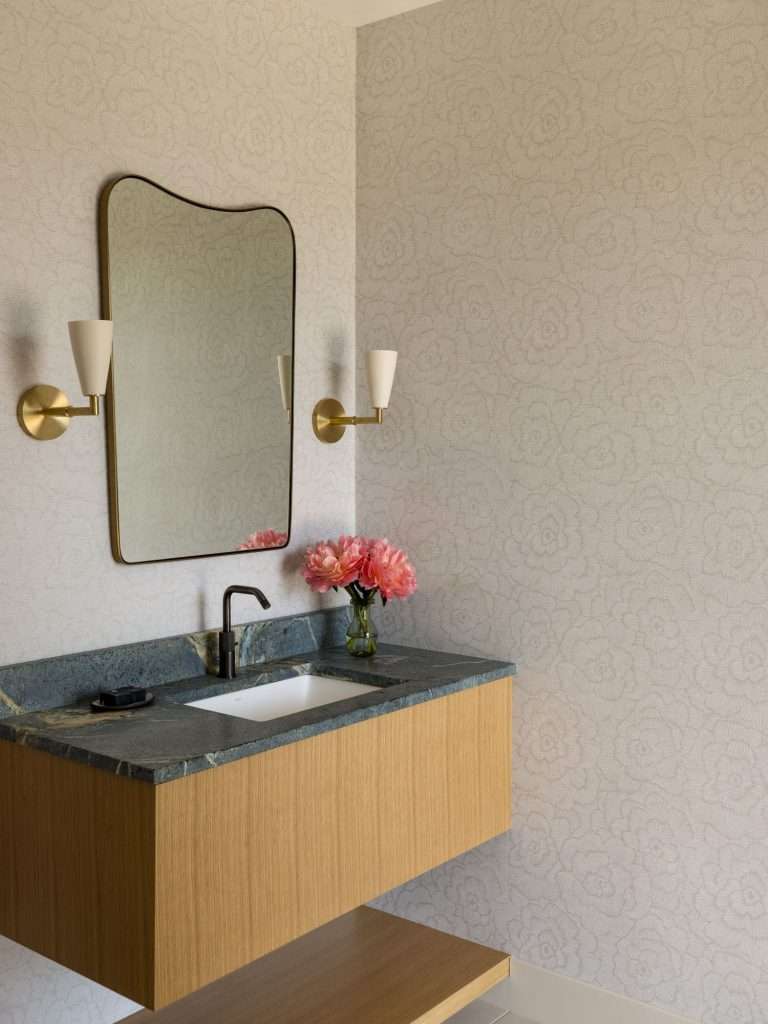
When your powder bath feels like a phone booth with plumbing, suspending the vanity off the floor creates an instant spaciousness that’ll make you do a double-take.
Here’s the magic:
When tile flows underneath that cabinet, your eye keeps traveling instead of stopping at a solid base. That continuous surface? Sugar, that’s pure visual trickery that makes your tiny powder room feel like it doubled in size overnight.
It’s simple, but trust me, it works every time.
And again, day-to-day upkeep gets a lot easier. Sweeping and mopping around the base takes seconds, which means no more toe-kick grime and mystery dust bunnies hiding in corners.
Lighting That Makes Guests Look Good (and the Room Look Expensive)
You could have the fanciest powder room fixtures money can buy, but if the lights cast shadows that make guests look like extras in a horror movie, honey, you’ve already lost the battle.
Now, for the good news:
The secret to a flattering glow isn’t some designer mystery. It’s all about positioning your fixtures right for a soft, balanced light that feels warm and welcoming, while still being bright enough for everyday use.
Mirror-Level Lights That Flatter Every Face
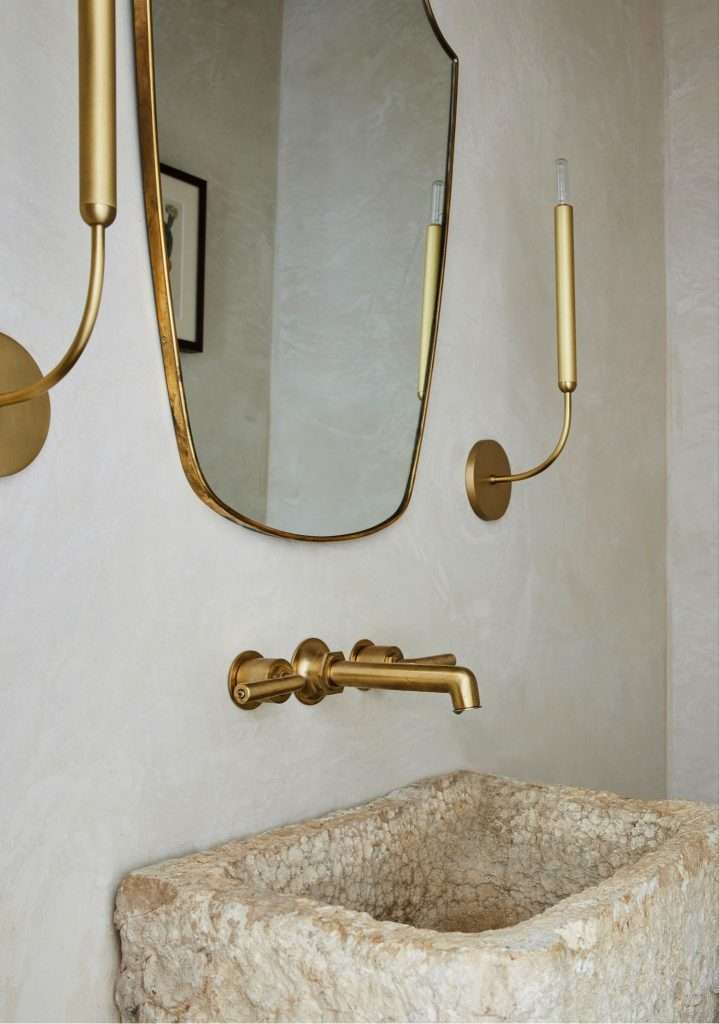
Everyone deserves to look fabulous when they catch their reflection in the powder bath, darling, and that’s exactly where mirror-level task lighting swoops in to save the day.
The easiest way to achieve that?
You need the right brightness aimed at precisely the right spots, honey.
Fixtures placed on either side of the mirror provide the most flattering results. They spread light across the face from both directions, which helps reduce shadows under the eyes, nose, and chin.
I usually place wall sconces about 60 to 66 inches from the floor. This height allows the light to hit the face at a comfortable level while keeping the glow soft and balanced.
Another option is a backlit mirror or an integrated LED mirror. You skip additional fixtures while delivering that shadow-free illumination. It’s a win-win, hun.
Layered Lighting for a Warm Glow
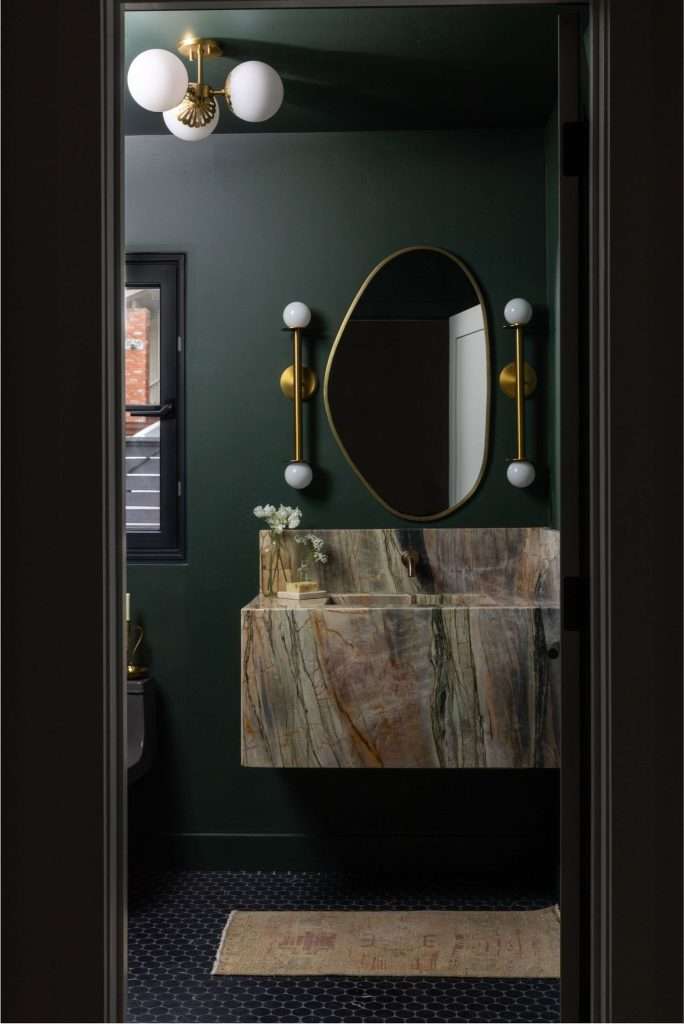
A single ceiling light rarely does your powder bath any favors. It brightens the room, sure, but it also tends to create harsh shadows and flat lighting.
Layered lighting can solve that problem, transforming a basic powder bath into a space where your guests actually want to linger.
So, instead of relying on a single fixture, combine a few light sources that work together. Each one plays a different role:
Task lighting illuminates the mirror area, while ambient lighting fills the room with a soft overall glow.
Dimmers make an even bigger difference. They allow the lighting to adjust throughout the day, keeping the room bright and practical, with the option to dial down the brightness level when needed.
Trust me, when the lights are balanced, the entire bathroom feels warmer and more dimensional. Just look at our Sarah Project, and you’ll see what I mean.
Decorative Fixtures That Double as Jewelry
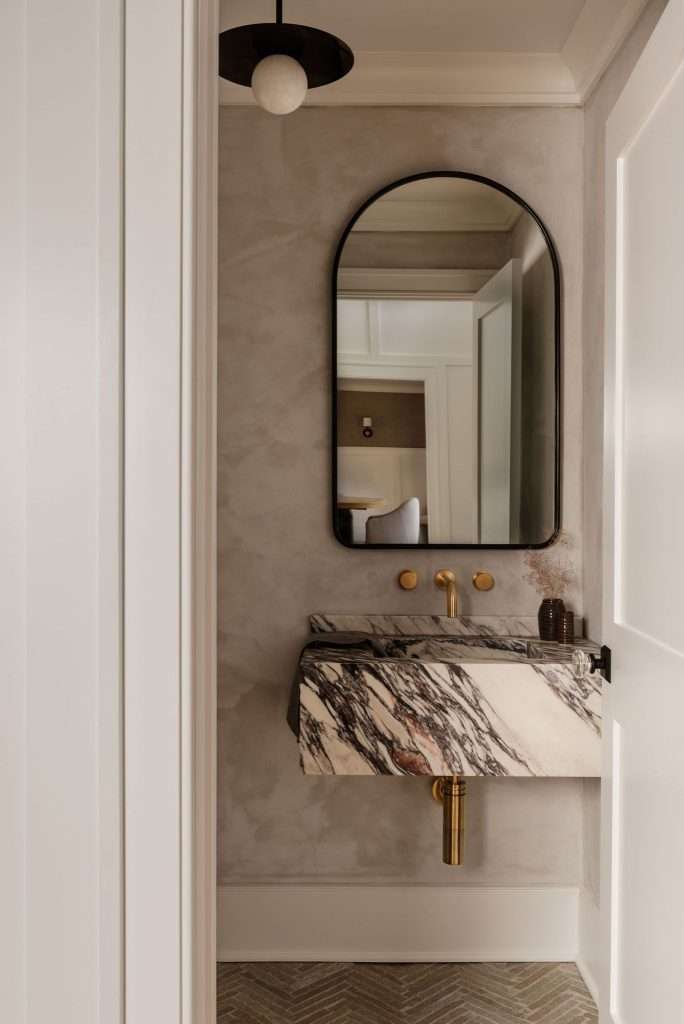
Powder rooms are one of the few places in the home where lighting can lean a little dramatic. Because the space is small, even a modest fixture can feel special.
This is where a decorative pendant, sculptural sconce, or small chandelier can shine.
You can think of these pieces as jewelry for the room.
They draw the eye upward, add a little personality, and give the powder bath a moment of visual interest. In many cases, they also help make your ceiling feel taller by pulling attention toward the upper part of the space.
Of course, the key is balance.
A decorative fixture should complement the mirror and sink area rather than compete with them.
During your bathroom remodel, Design on a Dime Interiors carefully plans fixture placement, layering, and light temperature, so the room feels warm, flattering, and inviting every time the switch flips on.
Wall Treatments That Turn a Powder Room Into a Jewel Box
Powder rooms are one of the few spaces in your home where you can take design risks and have fun with them. Why?
Well, honey, since the room is small, bold choices feel intentional instead of overwhelming.
Your walls have their own starring role to play here.
I often treat powder baths like little jewel boxes. Rich color, textures, and patterns on the wall can instantly transform the space from simple to striking.
Wallpaper That Brings Personality to the Room
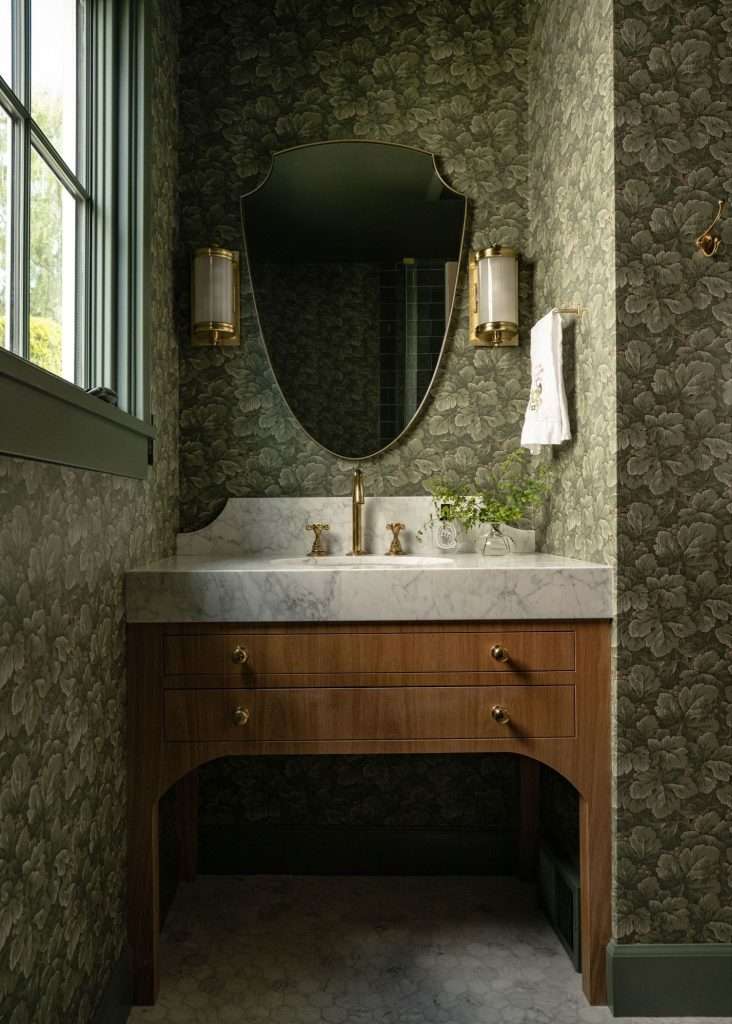
Wallpaper is one of the easiest ways to add character to a powder bath, hun. And since the space is pretty small, even a dramatic pattern can feel balanced rather than busy.
So, yes, now’s your chance to go all out.
A softer botanical print, for example, can bring a sense of calm and elegance. A bold geometric pattern, on the other hand, can add energy and modern style. Textured wallpapers, like grasscloth or linen, bring a subtle depth that catches the light beautifully.
The trick?
Choosing a pattern that complements the other finishes in the room.
If the mirror frame or faucet carries warm metal tones, look for wallpaper with similar warmth in the palette, ‘cause when everything speaks the same visual language, things feel polished, not pieced together.
Another design trick I love is combining wallpaper with wainscoting or painted paneling. The lower half of a wall stays calm and structured, while the wallpaper above adds interest and personality.
Paneling and Millwork for Architectural Depth
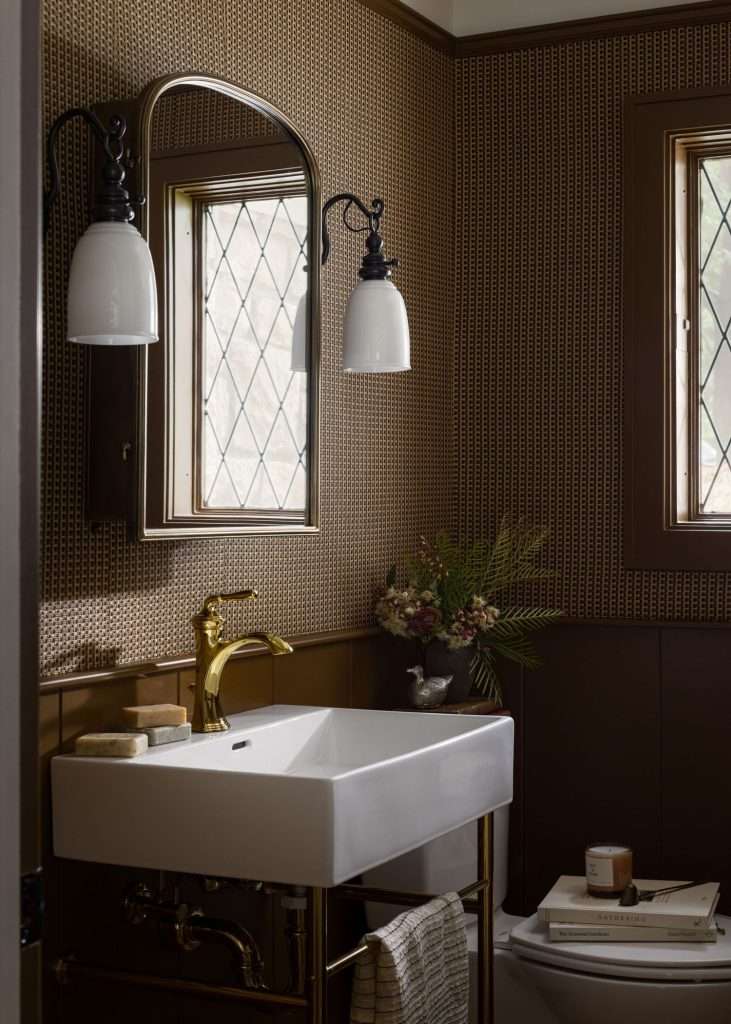
If wallpaper brings personality, paneling brings structure.
Millwork details, such as wainscoting, board and batten, or simple wall panel molding, can give a powder room that tailored, built-in look most folks associate with high-end homes.
Even subtle trim work adds dimension.
Light and shadow move across the panels throughout the day, which gives the walls quiet depth that paint alone can’t really create.
And the best part about paneling? It works with almost any style.
It can feel classic, modern, or even somewhere in between; it all comes down to the trim profile and paint you choose.
And that, honey, is how your powder bath becomes a small room with a big sense of presence.
Design on a Dime’s team uses these wall treatments to transform a compact powder bath into a standout space that still feels connected to the rest of the home.
Metal Finishes That Bring Warmth Without Taking Over the Room
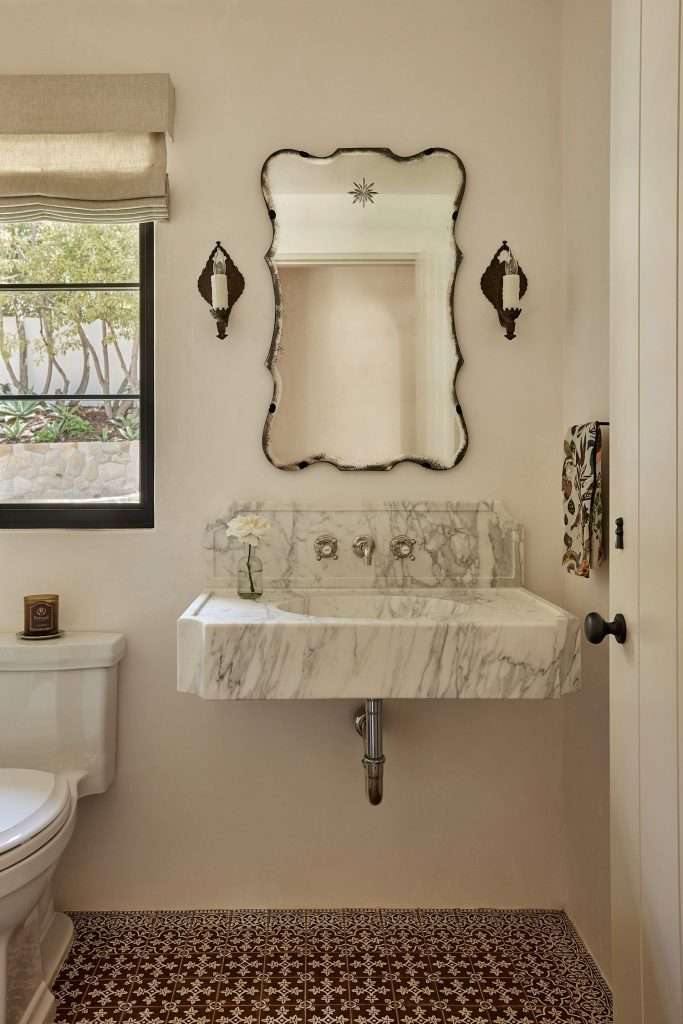
Metal finishes might seem like a small detail in a powder bath, but they quietly influence the entire mood of the space. Your faucet, cabinet hardware, mirror frame, and lights all introduce touches of metal that catch the light and add contrast.
When those finishes feel balanced and intentional, the room looks layered. But add too many competing metals, though, and the space can get busy, fast.
Mixing Metals Without Creating Visual Chaos
You know those Pinterest boards where the bath looks like it stepped straight out of a designer showroom, featuring four different metal finishes that somehow work together?
Yeah, that’s a trap.
You can mix finishes in your powder bath, as long as you do so with restraint.
For starters, stick to two finishes maximum. I recommend choosing one primary metal that appears on the most prominent fixtures, including the faucet and cabinet hardware. A second finish can then act as a supporting accent on your lighting, mirror frames, or accessories.
That way, you keep things cohesive while still introducing contrast.
On that note, contrast tends to work better than near matches.
Polished chrome loves antique brass. They’re practically high-contrast besties. But polished chrome next to satin nickel? That’s just awkward confusion.
Placement Rules That Keep Everything Cohesive
Once you choose your finishes, placement becomes just as important as the metals themselves. I’d even say it’s your secret weapon for creating that “looks expensive, doesn’t look crazy” vibe.
A good rule of thumb is to repeat each finish at least twice in the room.
Repetition helps the eye move naturally around the space and prevents any one piece from looking out of place.
For example, if brass appears on the faucet, it can also show up in the mirror frame or light fixture. If matte black enters the design through a sconce, repeating it in a towel ring or cabinet pull can help the room feel balanced.
Think balance, darling, not chaos.
A Powder Bath That Feels Connected to the Rest of the Home
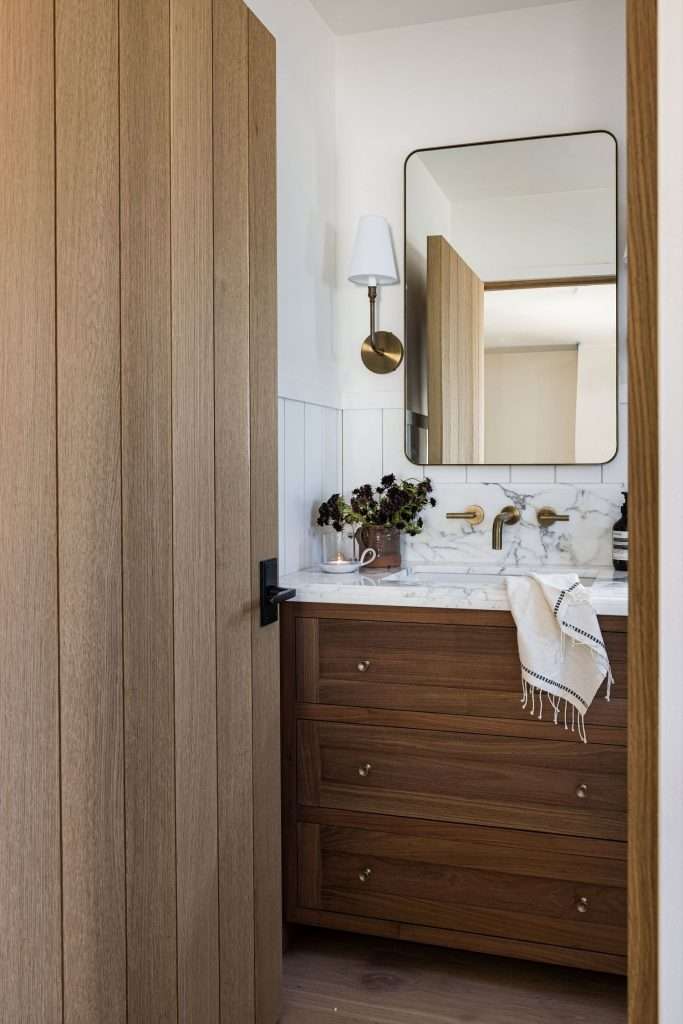
Your powder bath shouldn’t feel like it got teleported in from a completely different house. We’re not going for a separate little world tucked off in the hallway here. We’re going for something that feels connected to the rest of the home.
And trust me, darling, creating that smooth visual handoff between your powder room and adjacent living spaces is way easier than you think.
Guests might not stop to analyze why the room feels so polished, but they’re gonna notice that everything works together.
- Sightlines That Set the First Impression
Many powder baths sit just off a hallway, foyer, or living space, which means the doorway typically frames the space before anyone even steps inside. So, you want to pay close attention to that first glimpse. If your powder bath door opens toward a hallway, the mirror wall or a statement wallpaper might be the first thing visible from the outside. Picking a focal point that looks intentional from that angle helps the space feel welcoming right away.
- Materials That Carry the Design Story Forward
One of the easiest ways to connect a powder bath to nearby spaces is through material continuity. The idea is simple, really. Repeat a few key materials from the surrounding areas, so the transition between rooms feels smooth. If your home features warm wood flooring in the hallway, the powder bath might echo that warmth through wood accents or cabinetry. If natural stone or marble appears in the kitchen, similar tones can show up in the powder room tile. You get the idea, hun.
- Repeating Finishes for a Cohesive Look
Finishes are another quiet way to tie the room into the larger design. The metal used for lighting or faucets in your powder bath can echo the finishes found in nearby spaces. For example, if brushed brass hardware appears in the kitchen or entryway, carry those same tones into the powder bath to create a subtle connection. Colors can work the same way. Of course, none of these choices need to match perfectly. The goal is simply to repeat a few familiar elements so the room feels related to the rest of the home.
When that connection is handled with care, the powder bath stops feeling like an afterthought. It becomes a natural extension of your home’s design, right down to the smallest details.
Where to Save and Where to Splurge During Renovations
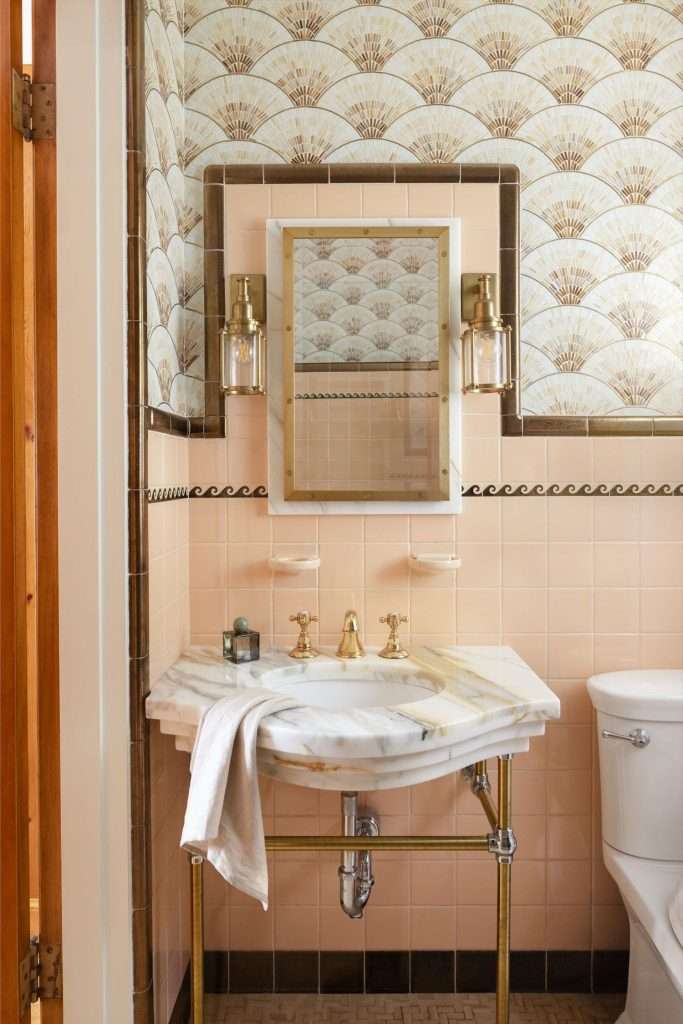
Now that you’ve got your powder bath looking like it actually belongs in your house, let’s talk about where to drop your dollars and where to hold back, because darling, not every single element in that tiny room is gonna deserve your entire paycheck.
My advice is to focus your budget on the features people notice first. Then, you save money on the pieces that quietly do their job in the background.
Here’s your game plan:
- Where a Splurge Makes the Biggest Impact
Start with the elements that create the strongest visual impression. The mirror, the lighting, and the faucet, for example, generally sit at eye level, catching the light and drawing attention the moment someone walks into the room. Investing in quality here can elevate the entire space. And because powder baths are small, these upgrades often cost less than they would in a larger bathroom. That makes them a smart place to introduce a little luxury.
- Where It Makes Sense to Save
Other elements can stay simple without sacrificing style. Standard toilets, for example, perform just as well as any higher-end model. A clean, well-designed fixture will blend right into the background once the rest of the room comes together. Tile is another area where thoughtful choices could keep your budget in check. Instead of covering every single wall with expensive materials, simply create a focal point; think a stunning tile floor or a small tiled accent area. Oh, and don’t forget about paint and wallpaper; they can deliver a big visual impact for a relatively modest investment.
That said, be sure to leave a little room in your budget for the unexpected.
Renovations sometimes uncover surprises once the walls and floors are opened up. Setting aside a small contingency allows the project to move forward, even if something unexpected does appear.
A successful powder bath remodel often comes down to knowing where design investments will have the biggest visual impact. That balance is something Design on a Dime Interiors can help you navigate.
Finishing Touches That Make It Look Professionally Designed
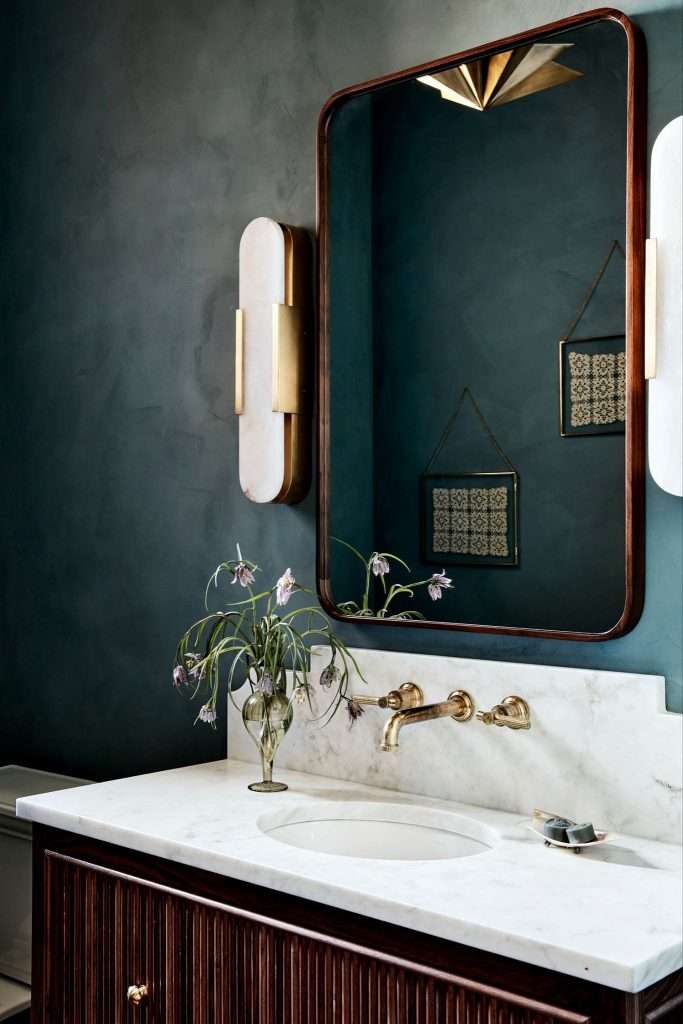
Let me tell you what really separates the “meh” powder baths from the “magazine-worthy” ones:
It’s all in those carefully chosen details, sugar!
These little things have the power to turn a functional room into a place that feels polished and cared for. When people step inside, they’ll notice the atmosphere right away, even if they can’t quite explain why it feels so put-together.
A few thoughtful layers can bring warmth, personality, and a little bit of everyday luxury to the space:
- A Simple Tray That Keeps the Vanity Neat
Vanity surfaces can start to feel a bit cluttered if every item sits on its own. A small tray solves that problem, sugar. Grouping hand soap, lotion, or a small decorative object on a tray instantly makes the arrangement feel intentional. It keeps the counter all tidy while creating a tiny focal point beside the sink. It’s a win-win. Be sure to choose a tray that complements the room’s finishes, though. For example, think marble trays with brass fixtures, or a wood or lacquer tray to soften a more modern powder bath.
- Artwork That Adds Personality
Artwork brings life to a powder bath in a way few other elements can. Because this space is small, even a single framed piece can have a strong presence. A landscape, abstract painting, or even a black-and-white photograph can introduce color and character without overwhelming the room.
- A Fresh, Welcoming Scent
Scent is one of those quiet little details that folks usually notice the moment they walk in. A candle, reed diffuser, or small room spray can help the space feel clean and inviting. On that note, choose light floral notes, fresh citrus, or soft woodsy scents; these tend to work well in bathrooms because they feel light and refreshing. The best part? The container itself can also double as décor.
These finishing touches might be small, but trust me, hun, they’re often what guests remember most about the room.
Frequently Asked Questions
What size mirror works best in a small powder room?
In many cases, larger mirrors work better in a small powder room. A mirror that spans most of your vanity width or extends higher on the wall reflects more light and makes the room feel more open.
How often should powder room design be updated for trends?
You should refresh your powder room’s design every 5 to 7 years to stay current with new trends, although timeless materials, including natural stone and quality fixtures, can extend that timeline considerably while keeping it stylish.
Is it okay to use dark tile in a small powder bath?
Yes, it absolutely is. In fact, darker tile can add depth and drama, especially when paired with good lighting and reflective elements, such as mirrors or warm metal finishes.
What type of lighting temperature works best in a powder room?
Most designers recommend warm white lighting between 2700K and 3000K for powder rooms. This range creates a soft, flattering glow that feels comfortable while still providing enough brightness.
A Small Room That Leaves a Lasting Impression
Listen up, darling:
Your powder bath might only take up a few square feet of your home, but it carries a surprising amount of design influence. It’s often the one room every guest sees, and it has a way of setting the tone for how the rest of the house feels.
When the lighting feels warm, the materials flow with the surrounding spaces, and all the finishing touches feel like they were picked out with care, that little room can carry quite a bit of confidence.
And no, it doesn’t need to be oversized or overdone to make an impression.
If you’re thinking about refreshing a powder bath or planning a renovation, Design on a Dime Interiors can help you create a space that feels polished, personal, and connected to the rest of the home.
Get in touch with our team today. Your powder room’s waiting for its glow-up!